
    Non-surgical, day-case treatment at a JCI hospital

    Gastric Balloon in Turkey — Orbera, Allurion & Spatz3 Options (2026)

    Compare three temporary gastric balloon options in Istanbul with screening and clinician-led follow-up. Treatment starts at £1,900, involves no abdominal incisions and lasts from about four to 12 months.

    2026 price
    From £1,900
    2026 price
    No abdominal surgery
    Day case
    No abdominal surgery
    Endoscopic options
    6–12 months
    Endoscopic options
    Balloons by Dr Üstün
    700+
    Balloons by Dr Üstün
    Summarize with AI

    QUICK ANSWER

    IBC offers Orbera for £1,900, Allurion swallowable for £2,600 and Spatz3 adjustable for £2,900. All are temporary, non-surgical stomach balloons performed as day cases for suitable patients at JCI-accredited Liv Hospital Vadistanbul. Orbera remains six months, Allurion about 16 weeks and Spatz3 up to 12 months. Typical total body-weight loss is 10–15%, but the device works only alongside a structured programme.

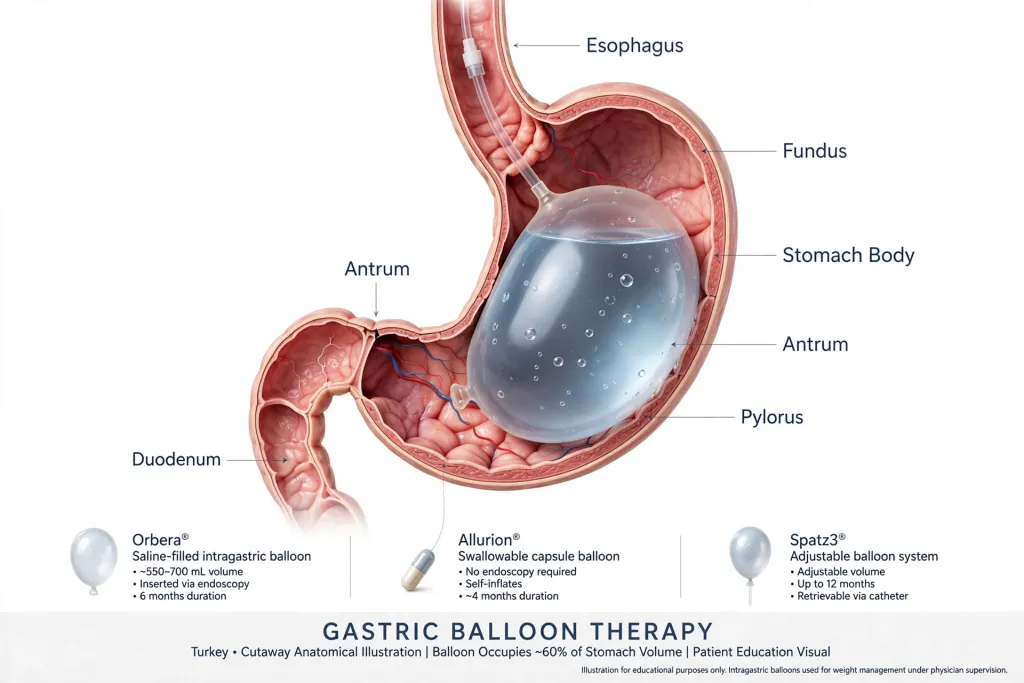
    Labelled cutaway diagram showing a gastric balloon inside the stomach

    Gastric balloon Turkey at a glance

    SpecificationDetail
    TreatmentTemporary intragastric balloon; no abdominal incision or stomach removal
    OptionsOrbera, Allurion swallowable and Spatz3 adjustable
    Placement20–30 minute day case; method depends on balloon
    AnaesthesiaLight sedation for Orbera and Spatz3; normally none for Allurion
    Time in stomachAbout 16 weeks to 12 months
    Typical result10–15% total body-weight loss at six months
    Usual BMI range27–40, subject to full clinical assessment
    HospitalJCI-accredited Liv Hospital Vadistanbul
    2026 priceFrom £1,900

    A balloon occupies space in the stomach so a smaller meal can produce fullness. It does not reroute digestion or directly cause permanent metabolic change. Its real purpose is to create a supported period in which portion size, meal structure and activity become repeatable habits.

    Orbera vs Allurion vs Spatz3

    The least invasive option is not automatically the best one. Selection follows medical review, practical preference and the support you need.

    Orbera vs Allurion vs Spatz3
    FeatureOrberaAllurionSpatz3
    PlacementEndoscopySwallowed capsule; X-ray checkEndoscopy
    AnaesthesiaLight sedationNone normallyLight sedation
    Duration6 monthsAbout 16 weeksUp to 12 months
    Fill volume400–700 ml saline550 ml salineSaline volume is adjustable
    RemovalEndoscopy at month 6Designed to deflate and passEndoscopy by month 12
    Price£1,900£2,600£2,900
    Best forEstablished six-month endoscopic optionEligible patients avoiding endoscopyPatients who may benefit from volume adjustment

    All options require clinical eligibility. Request a written plan before arranging travel.

    2026 gastric balloon prices and what is included

    Orbera

    £1,900

    Six-month endoscopic balloon with placement and planned removal endoscopy.

    Allurion

    £2,600

    Swallowable 550 ml balloon designed to pass naturally at about 16 weeks.

    Spatz3

    £2,900

    Adjustable endoscopic balloon for up to 12 months, with planned removal.

    Each package includes remote pre-assessment, the selected placement procedure, indicated anti-nausea and acid-suppression medicines, written diet guidance and dietitian follow-up at one, three and six months. Orbera and Spatz3 include removal endoscopy at the appropriate endpoint; Allurion normally needs no removal procedure. Additional investigation or treatment for an unrelated condition or complication is not automatically included.

    These balloon prices do not include flights, hotel or airport transfers unless your written quotation expressly adds them. This is consistent with a short day-case pathway rather than a multi-night bariatric surgery package. Do not assume that “all-inclusive” means every travel expense: ask for each item in writing before booking.

    How each gastric balloon is placed

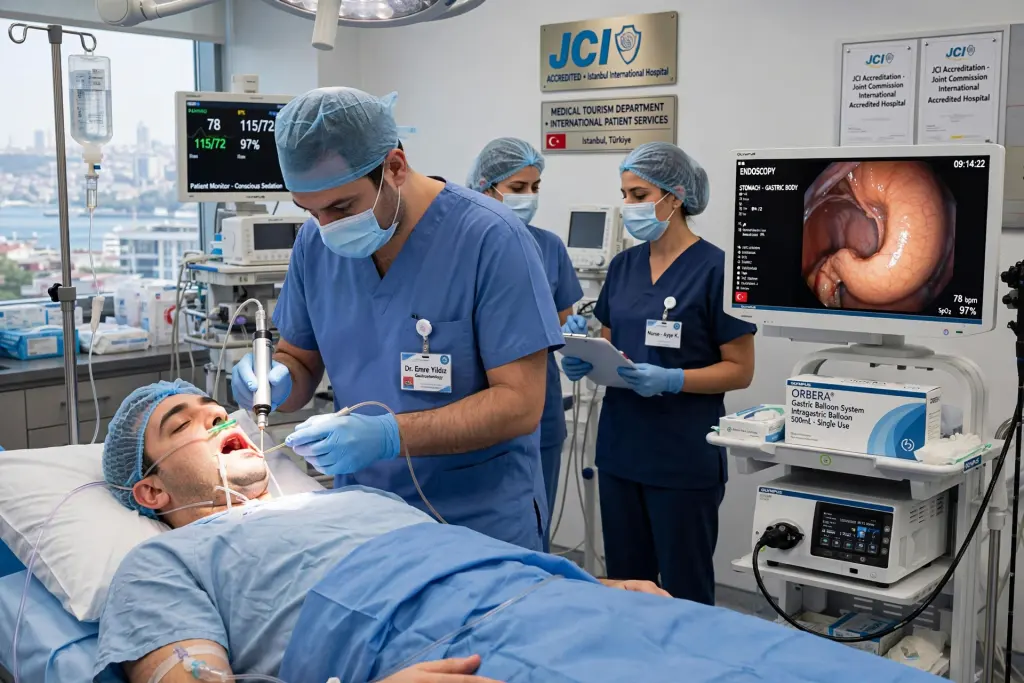
    Orbera: after an overnight fast and pre-procedure checks, the clinician passes an endoscope through the mouth under light sedation. The empty silicone balloon is positioned in the stomach, filled with 400–700 ml of sterile saline and checked. Placement usually takes 20–30 minutes. It is removed by a second endoscopy at six months.

    Orbera gastric balloon placement in an endoscopy suite

    Allurion: the deflated balloon comes in a capsule connected to a fine filling catheter. Most patients swallow it independently. A single X-ray confirms that it has reached the stomach, 550 ml of saline is added, and the catheter is detached and withdrawn. No anaesthetic or endoscopy is normally needed. At about 16 weeks, a time-release valve opens so the balloon empties and passes naturally.

    Patient swallowing the Allurion gastric balloon capsule under clinical supervision

    Spatz3: this balloon is inserted endoscopically with sedation and filled with saline. Its distinguishing feature is an adjustment catheter: the volume can later be increased to renew restriction or decreased if tolerance is difficult, following an individual review. Adjustment and final removal require endoscopy. It may remain in place for up to 12 months.

    All three are day-case pathways, but “non-surgical” does not mean casual or risk-free. You still need an accurate medical history, fasting instructions, safe discharge arrangements and prompt access to advice if symptoms exceed the expected adjustment period.

    An honest recovery guide: the first three weeks

    The first three to seven days are often the hardest. Nausea, retching, vomiting, upper-abdominal cramping, reflux and tiredness are common because the stomach is reacting to a new object. Prescribed anti-emetics and a proton-pump inhibitor (PPI) reduce symptoms, but they do not guarantee a symptom-free week. Hydration matters more than rushing back to normal meals.

    StageDietPriorities
    Days 1–3Clear fluids in frequent small sipsHydration, medicines and rest
    Days 4–7Smooth purée as directedSlow intake; stop at pressure or nausea
    Week 2Soft solidsProtein-first meals and careful chewing
    Week 3 onwardFull soft diet, then textures as toleratedSmall portions and structured meal timing

    About 2–5% of patients require early removal because intolerance does not settle. Contact the team for persistent vomiting, inability to drink, worsening pain or marked abdominal swelling. Severe pain, fever, breathing difficulty, blood in vomit or stool, fainting or sudden deterioration requires urgent local medical assessment rather than waiting for an online response.

    Expected weight loss — and what happens afterwards

    Average total body-weight loss is around 10–15% at six months. In practical terms, total body-weight loss is measured against starting weight: a person beginning at 100 kg would lose 10–15 kg at that range. This is an average, not a promise. Starting BMI, tolerance, eating behaviour, activity, sleep, medicines and attendance at follow-up all affect the outcome.

    Allurion has a shorter device period, with average total body-weight loss of 10–15% reported at approximately 16 weeks. The Orbera schema also notes that around 30% reached at least 25% excess weight loss in its FDA pivotal trial. These are different outcome measures and should not be treated as interchangeable.

    The balloon eventually leaves the stomach, and appetite or portion capacity may rise. Weight regain is a meaningful risk without a continuing programme. Dietitian reviews at one, three and six months are therefore not an optional extra: they are where you practise meal planning, identify trigger patterns and prepare for removal or passage. Long-term success depends more on what remains after the device than on the device itself.

    Who may be a candidate?

    • BMI approximately 27–40, after individual clinical assessment
    • Previous medical or lifestyle weight-loss attempts have not produced enough progress
    • A realistic goal compatible with typical 10–15% total body-weight loss
    • Willingness to follow the staged diet, medication and hydration instructions
    • Commitment to dietitian reviews and habits that continue after the balloon
    • Preference for a temporary option without abdominal incisions

    Who should not have a gastric balloon?

    • Previous gastric or bariatric surgery that changes anatomy or raises placement risk
    • A large hiatus hernia or significant oesophageal disease
    • Active gastric or duodenal ulcer disease
    • Pregnancy, breastfeeding or near-term pregnancy plans
    • Anticoagulation that cannot be safely managed for an indicated endoscopy
    • An active eating disorder, uncontrolled psychiatric illness or inability to follow care

    Side effects, risks and warning signs

    No balloon is risk-free. Published frequency varies by device and patient, and your consent discussion should cover risks specific to your history.

    RiskFrequencyResponse
    Nausea, vomiting and crampsCommon, especially days 1–7Anti-emetics, hydration, staged diet; review if persistent
    RefluxCommonPPI, meal timing and clinical review
    UlcerationUnder 1%Acid suppression; endoscopy and treatment if suspected
    Early removal for intoleranceAbout 2–5%Endoscopic removal when symptoms cannot be controlled
    Deflation or migrationRareUrgent imaging or endoscopic/surgical management
    PancreatitisRareUrgent assessment for severe persistent upper-abdominal pain
    Spontaneous hyperinflationRarePrompt assessment, imaging and removal when indicated

    Balloon migration can very rarely lead to bowel obstruction. Hyperinflation can cause increasing pain, distension, vomiting or breathing discomfort. New severe symptoms are not something to “push through”. Seek urgent local care and tell clinicians which device you have and when it was placed.

    Gastric balloon vs ESG vs gastric sleeve

    FeatureBalloonESGSleeve
    MethodTemporary device in stomachInternal endoscopic suturesPermanent surgical stomach removal
    IncisionsNoneNoneKeyhole abdominal incisions
    Typical roleModerate, temporary aidGreater endoscopic restrictionGreater and more durable surgical treatment
    ReversibilityDevice leaves or is removedPotentially revisable; anatomy retainedNot reversible
    RecoveryUsually several difficult adjustment daysUsually days, with staged dietUsually 1–2 weeks to light work

    A balloon can be appropriate when a temporary 10–15% total body-weight loss target matches the clinical need. Endoscopic sleeve gastroplasty uses sutures to reshape the stomach without removing it and may offer a different balance of durability and invasiveness. Gastric sleeve in Turkey permanently removes a large part of the stomach and is considered for patients needing surgical-level treatment. Compare the detailed balloon versus sleeve guide, but let health needs—not price alone—drive the decision.

    Surgeon's Perspective

    Dr Üstün and Liv Hospital Vadistanbul

    By Dr Murat Ustun

    MD, PhD · 25+ years · BOMSS and IFSO member

    Op. Dr Murat Üstün has 25+ years of experience, 6,000+ advanced laparoscopic procedures and 700+ gastric balloon procedures. His professional memberships include BOMSS and IFSO. His approach begins by asking whether a temporary device can realistically match the patient’s health needs and expected degree of weight loss.

    Eligible patients are treated at JCI-accredited Liv Hospital Vadistanbul, where endoscopy, anaesthesia, imaging and escalation facilities are available. Experience and accreditation do not remove risk, but a named clinician, appropriate screening and a properly equipped setting are important parts of responsible international treatment.

    Gastric balloon Turkey FAQs

    Check which gastric balloon may suit you

    Request a free, no-obligation clinical review. Share your medical history, medicines, previous procedures and weight goals to receive a suitability assessment and written 2026 quotation.

    Reviewed by Op. Dr Murat Üstün, MD, PhD · Last reviewed 17 September 2026